
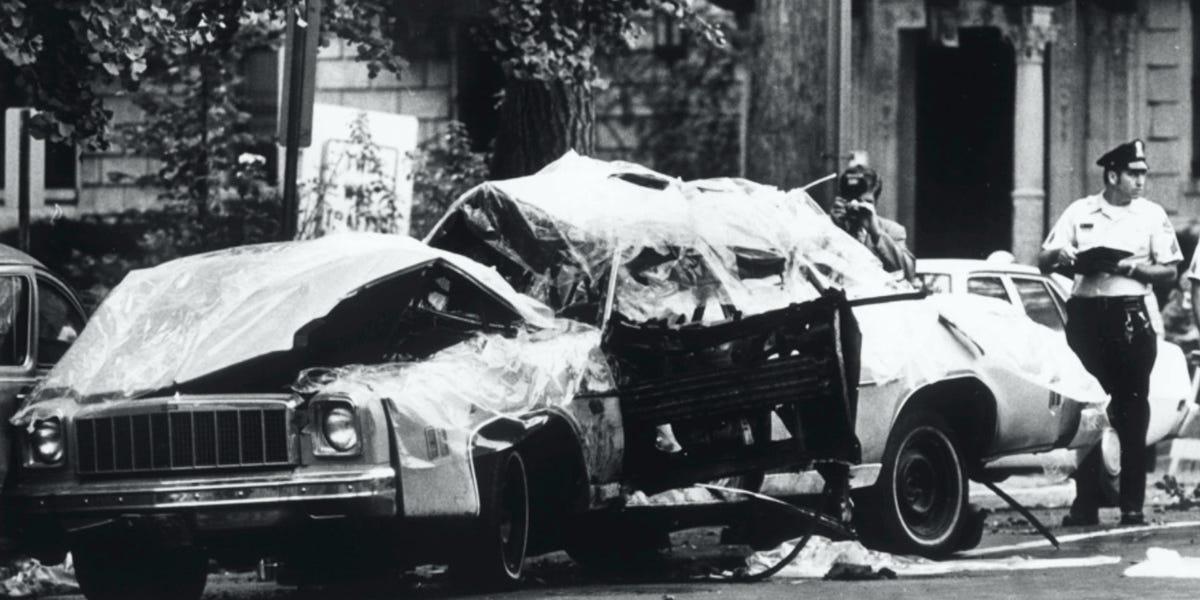
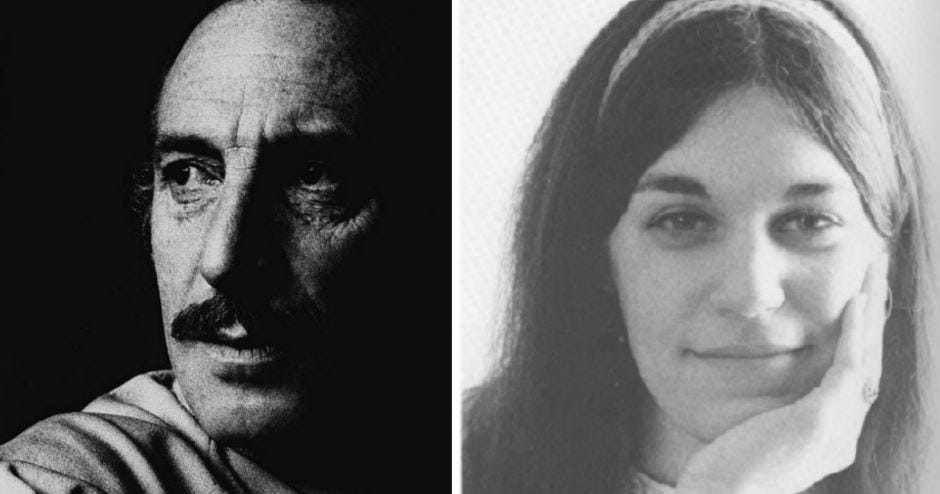
The plan was diabolically audacious: In the summer of 1976 Chile’s secret police sent assassins to carry out a car-bomb murder in downtown Washington, D.C. The target was Orlando Letelier, a former senior official in the socialist government of Salvador Allende, ousted in a military coup three years earlier. A former ambassador to the United States, Letelier had become an influential, charismatic leader of the opposition abroad from his perch in Washington, at the leftwing Institute for Policy Studies. Fifty years ago this week, the assassins struck, detonating a bomb under Letelier’s car as he drove along the city’s elegant Embassy Row, killing him and a young colleague, Ronni Karpen Moffitt.
I’ve been investigating this grisly murder for decades. Bad as it was on its own, I have discovered an even worse aspect to the event: The CIA knew at the time that such extraterritorial attacks were being prepared by a secret consortium of Latin American military regimes, including Chile. And I’ve concluded that the 1976 assassination could have—should have—been prevented, based on documents I’ve obtained and interviews with key officials. Tragically, U.S. officials had drafted, but curiously failed to deliver, a strong warning to the regimes that was intended—as one official said—“to head off …a series of international murders.”
Now, two high ranking State Department insiders involved at the time have come to similar conclusions, based on their own experience and after seeing the evidence in U.S. declassified documents.
The Scene
Many Washingtonians still remember the seasonably pleasant, overcast day of the bombing, Sept. 21, 1976, when Massachusetts Avenue was paralyzed during the morning rush hour and much of the city was disrupted as hundreds of police and FBI agents converged on the scene. Associates of Letelier, including Saul Landau, my coauthor of a later book on the affair, feared they might be next. I was living in Chile and working as a part-time correspondent for The Washington Post, when I got a call from my editor, Karen DeYoung, telling me a bomb had exploded in a car registered to Letelier less than a half hour before. Moffitt, 26, had been hit by shrapnel and also died. Her husband Michael, 29, who was riding in the back seat, survived.
In Santiago, it became my sad duty to run to the Catholic Church-sponsored Vicariate of Solidarity to convey the news to human rights workers, including Letelier’s sister, Fabiola Letelier, a lawyer working at the agency, located next to the Metropolitan Cathedral of Santiago.
Back in Washington, the public spectacle and terror were clearly intentional, aimed at intimidating opponents of Chile and the other South American dictatorships. The terror was magnified by the revelation that the killings were part of a larger international plot, the so-called Operation Condor, an alliance of the security forces of six dictatorships organized to track down, kill, and torture hundreds of anti-regime exiles and other activists around the world.
We assumed that Chile’s dictator, General Augusto Pinochet, had ordered this audacious attack in the heart of the U.S. capital, where President Gerald Ford, but particularly his secretary of state, Henry Kissinger, were his regime’s most important defenders. Documents later revealed that Col. Manuel Contreras, chief of the security force, known as DINA, that directed the operation, had been on the CIA payroll and had been entertained at CIA headquarters at least four times in the two years prior to the assassination. It was Contreras who sent a team of agents, including an American expat and explosives technician, Michael Townley, to carry out the deadly mission with the support of Paraguay, another Condor member, and a group of rightwing anti-Castro Cuban exiles, who were recruited to help Townley affix the bomb and detonate it.
Letelier was a high profile target, an exile leader who moved comfortably and effectively within the circles of power in Washington D..C, where he had worked for a decade in international organizations and as Chile’s ambassador. He had represented Chile during the government of Marxist president Salvador Allende, whose grand but ultimately failed experiment called for a mix of free market and socialist economic policies undertaken amidst freewheeling democratic political debate, independent press and free elections. Gen. Augusto Pinochet, the Army’s commander, had led a violent military coup to overthrow Allende on Sept. 11, 1973—which became the first “9/11.” Letelier was minister of defense at the time of the coup—Pinochet’s titular boss—and he was imprisoned for a year on a remote island near the southern tip of the South America continent.
Released in September 1974 (after world leaders, including Kissinger, intervened on his behalf) he arrived in Washington D.C. to organize exile opposition to the Pinochet dictatorship and lobby members of Congress and other political leaders about Chile’s dreadful human rights record and to rally support for a return to democracy there. He established a similar operation in Holland to push European governments to cut military and economic ties with the Pinochet dictatorship. Immensely effective in both countries, he was being closely tracked by Chilean security. One unmistakable sign of his potential impact in Washington, and his danger to Pinochet: Kissinger, who had supported the military coup, invited Letelier to a private lunch in early 1976.
Condor’s Wings
Letelier was not the first nor the last Latin American exile leader to be assassinated in those years. The existence of Operation Condor was revealed in 1978 by the FBI, in the course of its investigation into the Letelier murder. (The CIA already had intimate and detailed information about the assassination alliance, but kept its information secret for more than two decades.) A source confided to the FBI’s legal attaché in Argentina, Robert Scherrer, that Chile, Argentina, and Uruguay had launched a military operation named Condor (after Chile’s national bird), which was dispatching assassination teams to Europe and Mexico and suspected of involvement in the Letelier assassination. The alliance included Brazil, Bolivia, and Paraguay. Together, the six Condor members ruled over 80 percent of South America’s population.
In 1978, while investigating the Letelier killing for my book with Saul Landau, Assassination on Embassy Row, Scherrer told me about Condor and shared with me his first cable revealing the outlines of Condor’s activities. I quoted the cable (later declassified) in the book, but for many years, the details about Condor were sketchy.
The U.S. government waited several decades before releasing more complete information in the thousands of documents declassified in large batches between1998 and 2019. I used those documents and interviewed hundreds of firsthand sources, including U.S. officials, victims, and Latin American military participants, to write my definitive accounts of the Letelier assassination and Condor in two more books, The Condor Years (2004) and Los Años del Cóndor (2021), a greatly expanded Spanish-language edition).
My database, published at the time of the 2021 book, documented the names and circumstances of 654 victims of the transnational repression that had been carried out by the Condor nations starting in 1973. Condor’s multinational teams were allowed to operate inside each of the member countries to track down and “disappear” dissidents who were living there after fleeing their own countries. The vast majority of Condor operations took place in Argentina, where thousands of exiles from Uruguay and Chile had sought refuge after military coups in their home countries. Citizens of those countries comprised 83 percent of the total Condor victims.
Those deadly covert operations took place on “friendly” territory and were facilitated by local authorities in the Condor countries. Chile, Uruguay, and Argentina also relentlessly pursued their enemies in hostile environments outside their own borders. Assassination teams, including specially trained Condor units called “Teseo” or Theseus, launched missions in Europe, the United States, and Mexico. A total of 45 elite political figures were targeted in 21 such operations.
The actions executed in European countries attracted special CIA attention and broader concern in the U.S. government. Unlike the Letelier operation, U.S. intelligence and in-country countermeasures are believed to have headed off most of the attacks. Operating in hostile territory, the Condor teams were forced to abandon the attacks in most cases, even after they had arrived in-country.
Much of what happened continues to be shrouded in secrecy and details of the failed operations are sketchy. I was able to establish that the CIA alerted European intelligence agencies, who appear to have detected most of the operations while they were underway and stopped them. Only one person, Noemí Gianotti de Molfino, a member of an underground Argentine group opposed to the dictatorship in Buenos Aires, was actually killed in Europe. Argentine agents captured her in Peru, whose military government had recently joined the Condor alliance, and brought her to Madrid as part of an effort to entrap another guerrilla leader. There, when the operation failed, she was executed and her body was found in a hotel. In another European case, Italian neofascist agents working for Chile, operating unilaterally, shot and wounded a prominent Chilean leader, Bernardo Leighton, on a street in Rome in 1975. Thirteen other planned European operations failed to harm their targets.
It was a record only equalled by Vladimir Putin’s Russia.
Going Deep
In our 1980 book, Landau and I were the first journalists to describe Condor in depth, based on information from the FBI. We also investigated the widespread theory on the left that the CIA might have had a role in the killing—because of the agency’s close ties with the Chilean military. We ruled out any participation by the CIA in the killings, but pointed to a series of unanswered questions about CIA knowledge of Chilean activity, including Condor. Many of the questions were answered in my 2003 book, The Condor Years, using evidence In a massive declassification ordered by the Clinton administration in 1999. In those releases the CIA finally revealed the extent of its penetration of Operation Condor, and the State Department declassified an August 1976 “demarche” signed by Henry Kissinger that was intended to stop Condor operations in Europe. One of Kissinger’s deputies, Harry Shlaudeman, in a key document just three weeks before the Letelier assassination, made explicit both the U.S. knowledge of Condor and the seriousness of the demarche’s message about its plans: “What we are trying to head off is a series of international murders that could do serious damage to the international status and reputation of the countries involved,” it said.
The demarche was never delivered. Kissinger canceled his order after weeks of vacillation by his ambassadors. Had it been delivered, I have argued, the assassination in Washington would not have occurred.
I laid out the facts supporting this conclusion in the 2021 expanded Spanish-language edition of my Condor book, published in Chile. Several State Department officials involved at the time agreed with me after seeing the evidence. Ambassador William Luers, who was Kissinger’s Deputy Assistant Secretary of State for Latin America at the time, endorsed my findings in his own 2024 book, Uncommon Company. The story, in brief, is that Kissinger initially reacted strongly to CIA intelligence about Condor’s plans for killings in Europe. In his demarche in late August 1976, which was drafted by Luers, Kissinger ordered U.S. ambassadors in Chile, Argentina, and Uruguay to warn top officials in those countries that the U.S. knew about the Condor assassination plans and opposed them. But the ambassador to Chile, David Popper, resisted acting on the order, arguing it would interfere with good relations with Pinochet. After weeks of delay, Kissinger backed off, influenced by other intelligence reports saying the Condor Teseo operations had been put on hold because Brazil objected to carrying out assassinations in Europe. As a result, Kissinger canceled the order, and the warning was never delivered to Chile.
It was a tragic decision. Kissinger and his team chose to ignore other streams of intelligence indicating that Chile was planning some kind of a secret operation in Washington, D.C. They also learned that two Chilean agents had obtained false passports in Paraguay – a Condor member–and were known to be heading to Washington to carry out an unspecified operation. U.S. officials also knew that two other exile leaders had been attacked abroad, including Leighton’s wounding in Rome and the murder in Argentina of Pinochet’s predecessor as commander of Chile’s Army, General Carlos Prats.
The demarche was never delivered. Kissinger canceled his order after weeks of vacillation by his ambassadors. Had it been delivered, I have argued, the assassination in Washington would not have occurred.
We now know, in fact, that Pinochet’s plan was to murder his most threatening exiled leader, Letelier, and that his intelligence force, the DINA, had already dispatched an assassination team to the United States. (It included the two men who had obtained the false Paraguayan passports, whose photos eventually led to the FBI’s ability to solve the case and accuse Chile.) A few days after Kissinger canceled the order, the agents carried out the car bomb attack on Embassy Row with the assistance of right-wing Cuban terrorists based in New Jersey.
Failures to Communicate
It is almost impossible to believe Pinochet would not have called off the assassination if he had received such a direct warning. Kissinger was his most important ally and international defender, and had recently made a friendly visit to Chile. Instead, Kissinger decided to call off the warning to avoid possibly offending Pinochet.
Ambassador Luers was in the middle of those fateful decisions in August and September 1976. He wrote the first draft of the Kissinger demarche intended to warn off Pinochet and the other Condor leaders against international assassinations. In many conversations with me in recent years, he said the failure to stop the Letelier operation weighed heavily on him. In his book he devoted a chapter to the case, entitled “When a Friend Acts Like an Enemy: Pinochet’s Chile and Operation Condor.” He describes how he spent weeks trying to push Popper, the U.S. ambassador, to deliver the message—either to Pinochet directly or to have it delivered by the CIA to the head of DINA. His conclusion: “The U.S. government could have headed off the assassination had there been an immediate and forceful presentation to Pinochet….” The U.S. government had considerable leverage with Pinochet, he argued, because it had supported him in his violent path to power. But the leverage was not used.
The complaisant response to such murderous plans and actions by Chile was part of a pattern. Another American official, Ambassador Jeffrey Davidow, who was a political officer in Chile at the time of the coup, linked Chile’s decision to kill Letelier in Washington to the U.S. government’s “lack of resolve” in failing to criticize the Pinochet regime for mass killings inside Chile, including its coverups of the murders of two young Americans in Santiago, Frank Teruggi and Charles Horman, during the coup. In an unpublished essay written in 1983 and provided to me, Davidow wrote: “The same cast of characters which got away with the murders of Horman and Teruggi, Letelier and Moffitt are still running the Chilean show. When the ‘tinto’ [red wine] is of a particularly good vintage and abundantly served,” he bitterly added, “they must laugh up their sleeves at our lack of resolve.”
Bloody Legacy
The victims and intended victims of Condor are a Who’s Who of Latin American politics of the era. They included, in addition to Letelier, three other top Chilean leaders of the left and center; Uruguay’s three most important congressional leaders; a former president of Bolivia; the wife and daughter of Salvador Allende; the chiefs of Marxist guerrilla organizations of Chile, Argentina, Bolivia, and Uruguay (who had formed an alliance based in Paris called Revolutionary Coordinating Junta (JCR); human rights and church leaders, and Rep. Ed Koch, a prominent New York Democrat. (Koch had sponsored an amendment cutting off military aid to Uruguay, thus prompting the Condor targeting; a Uruguayan officer revealed the plot in a drunken rant to a CIA agent and the intended action against Koch was averted.)
A half century later, Condor’s deadly, cross-borders legacy continues to reverberate in recent events, even in the United States. In the Condor years, when U.S.-supported dictatorships dominated South America, it was thought the violent transnational repression was an aberration, a one-time episode emerging out of rightist nationalism and anticommunism in the context of the Cold War. History proved us wrong. In the aftermath of the 9/11 al-Qaeda terrorist attacks in New York and Washington, international assassination as an instrument of state policy has become widespread, almost commonplace. Several states, particularly Russia, have dispatched assassins to murder opponents aboard (including in the U.S., according to a Justice Department indictment just last week). Israel also has made such assassinations a critical instrument of security policy, including the killing of dozens of nuclear scientists in Iran and Hezbollah leaders in Lebanon. Chinese operatives regularly threaten and kidnap opponents abroad, including in the U.S., according to indictments. The Ortega regime in Nicaragua has reportedly authored “at least 20 cases” of assassination plots and threats in recent years. All such targeted killings across borders are being carried out with increasing frequency and effectiveness, taking advantage of advanced weapons including, most recently, self-guided drones and missiles. It must also be acknowledged that successive post-9/11 U.S. administrations employed kidnapping and assassinations-by-drone as instruments of state power.
Condor’s criminal tactics, it turned out, served not just as a warning of authoritarian cruelty, but as a harbinger of things to come. ###
SpyTalk Contributing Editor John Dinges was a stringer for The Washington Post in Chile at the time of the assassination and later worked as an editor on the foreign desk. He served as deputy foreign editor and managing editor at National Public Radio, then was the Godfrey Lowell Cabot Professor of International Journalism at Columbia University. In addition to the books mentioned in the text, he is the author most recently of Chile in Their Hearts: The Untold Story of Two Americans Who Went Missing After the Coup (University of California Press 2025).