
Housing has become front-page politics. Zohran Mamdani’s mayoral campaign in New York City featured pledges to freeze rents and build hundreds of thousands of affordable homes, responding to an issue that is felt to be increasingly urgent nationwide. Public housing and rent control have bad track records, but Mamdani’s sense of urgency is justified. Why is housing so expensive? In most sectors, modern technological capitalism has brought plenty, making former luxuries cheap, and food plentiful, yet it seems harder than ever to get a roof over one’s head. What explains that?
Naturally, there are multiple factors. Partly, remote work has dialed up demand. Partly, housing is a financial asset that often tracks other financial assets such as stocks. But the real problem is the way housing supply is constrained by red tape.
To house people more affordably, we need to make homebuilding more efficient. But a deeply entrenched overregulation of land use and the building trades keeps homebuilding firms small and backward. Other industries—aviation, computing, agriculture, containerized shipping, manufacturing, retail, telecommunications, and so on—have raised productivity through deregulation, big business, innovation, automation, standardization, and scalability. Homebuilding needs to follow suit.
The Divergence of Home Prices and Paychecks
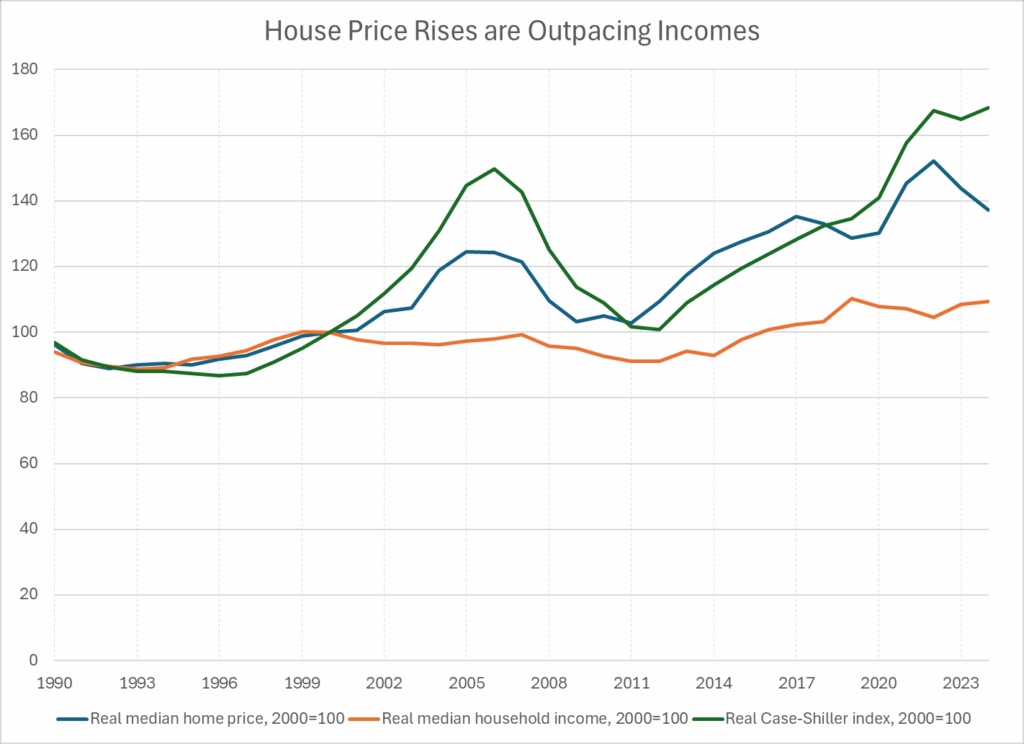
Housing really has become unaffordable for many people, and Figure 1 sheds light on this by comparing (a) the median sale price for homes, (b) the Case-Shiller home price index, and (c) median household income, all adjusted for inflation and normalized so that the year 2000 = 100. Together, they detail how home prices have diverged from paychecks.
Figure 1. The time trend towards housing unaffordability
Source: US Federal Reserve Economic Data (FRED), accessed October 2025. Series include:
- Median Sales Price of Houses Sold for the United States (MSPUS, US Census Bureau, quarterly)
- S&P CoreLogic Case-Shiller US National Home Price Index (CSUSHPINSA, S&P Dow Jones Indices LLC and CoreLogic, monthly)
- Median Household Income in the United States (MEHOINUSA646N, US Census Bureau, annual)
- Consumer Price Index for All Urban Consumers (All Items, SA) (CPIAUCSL, US Bureau of Labor Statistics, monthly)
The median home sale price has risen from a 1990 median of $293,630 to $418,975 in 2024 (in constant 2024 dollars). This can be misleading because of composition effects (rich versus poor doing more of the selling). The Case-Shiller index addresses that by tracking prices across repeat sales of the same houses for selected cities. It omits new houses and doesn’t sufficiently capture home improvements, but it gives meaning to a particular concept of housing affordability. The same houses that were affordable to middle-income families a generation ago are often unaffordable for them today.
Real median household income, also shown in Figure 1, hasn’t shown the steady uptrend that one would hope for. It rose and fell during the dot-com bubble and its aftermath, then rose and fell again during the 2000s housing bubble and its aftermath, and was lower in 2012 than in 1995. Since then, incomes have been rising, but haven’t kept up with housing prices. In the 1990s, it took roughly four years’ worth of median household income to cover the median home sale price. This surged to roughly five years in 2004–06, and approached six years in 2022. By the Case-Shiller measure, home prices climbed more than 50 percent relative to median incomes between the 1990s and the 2020s.
None of this quite proves that, in general, kitchens and bedrooms, central heating, front porches, and nice neighborhoods with good schools, etc., have become less affordable vis-à-vis basic earning power. Rising prices in established urban neighborhoods, as tracked by Case-Shiller, often reflect falling crime and other real improvements in quality of life. A benign urban revival has occurred in many places. And while homebuilding has slowed, new houses tend to be larger, while older houses get expanded, so the average family has more floor space than in the past. US cities have also tended to de-densify over time, so people are living their lives in less crowded spaces.
At best, rising home prices could be a win-win. Incumbent homeowners enjoy capital gains in pleasantly gentrifying neighborhoods, while income-constrained young families move further out, but get larger homes in spacious emerging neighborhoods with plenty of amenities and their own prospects for capital gain. But the reality is less benign than that.
When the Office Came Home
The recent surge in home prices reflects familiar factors—low interest rates and broad asset optimism—but also one distinctive shock: the mass breakthrough of remote work forced by the pandemic. When lockdowns hit in 2020, office work didn’t break, and managers discovered that the office was optional. Hours worked from home have fallen from a 2020 peak of 60 percent to about 27 percent, but the decline is leveling off. The best guess for the new normal is roughly one in four hours worked remotely.
A leap in productivity made cars affordable for ordinary families and helped create a middle-class way of life defined by mobility, household appliances, and a backyard for the kids. Housing needs a similar breakthrough.
This shift has clear long-term benefits for families, communities, and productivity, but awkward short-term consequences for housing. Mondragon and Wieland (2022) find that each additional percentage point of remote-work prevalence across metro areas corresponds to a 0.9 percent rise in house-price growth and may explain about 12 percent of the national increase in real home prices since 2019. The mechanism is intuitive: when people work from home, they consume more space. Extra bedrooms become offices; empty nesters postpone downsizing. Stanton and Tiwari (2021) show that remote workers choose larger homes and different locations, consistent with higher housing-space demand.
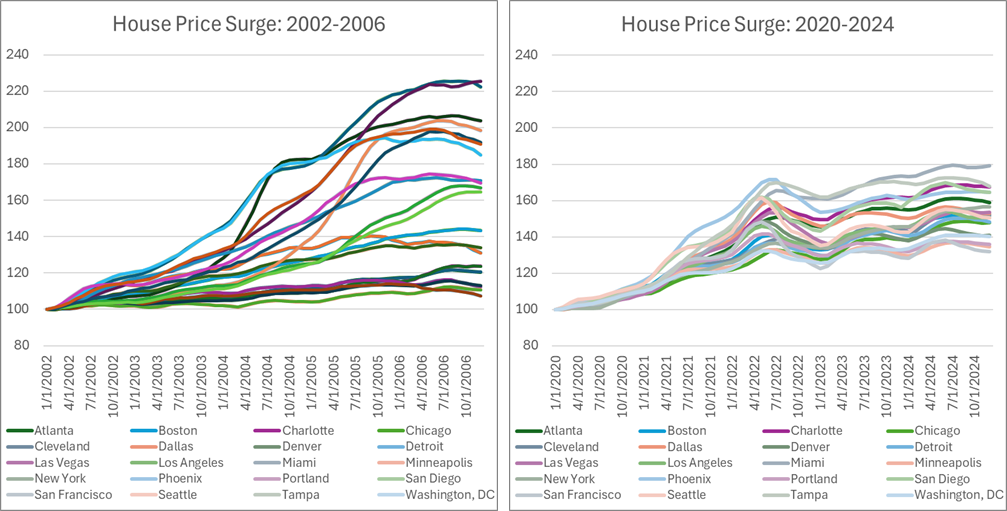
Remote work also helps explain why the 2020–24 housing boom was more evenly spread than that of 2002–06, as shown in Figure 2.
Figure 2. The house price surge in 2002–06 was concentrated, that of 2020–24 was diffuse
Source: US Federal Reserve Economic Data (FRED), accessed October 2025.
The earlier boom centered on “superstar” metros tied to the IT revolution, where proximity drove productivity. Today’s rise in prices is economy-wide. Freed from the daily commute, some remote workers operate as the arbitrageurs of housing markets—leaving expensive cities for cheaper regions and taking their jobs with them. That has narrowed inter-city price gaps but spread affordability pressures nationwide.
It’s widely recognized now that superstar cities’ costs drive workers away from high-productivity regions—and thus hurt national output. Those supply bottlenecks still weigh on productive metros, but remote work is beginning to outflank them—exposing another constraint: our inefficiency in building new housing. Remote work increases the need for space only modestly. Its large price impact stems from inelastic supply. When housing demand rises, a sluggish and bureaucratically hamstrung construction sector struggles to meet it.
Why We Need a Henry Ford of Housing
It would be nice if twenty-first-century homebuilding could emulate twentieth-century carmaking. Henry Ford’s assembly line raised output per worker by roughly 700 percent between 1913 and 1925, cutting the time to build a Model T from twelve hours to ninety minutes. That leap in productivity made cars affordable for ordinary families and helped create a middle-class way of life defined by mobility, household appliances, and a backyard for the kids. Housing needs a similar breakthrough.
The best proof of concept already exists where the automotive and real-estate sectors overlap: the mobile home. Factory-built housing achieves large productivity gains because it is standardized, mechanized, and—crucially—shielded from local red tape. Federal code preemption under the 1976 HUD Code created a nationwide market in which homes could be mass-produced and sold across state lines. That legal loophole allows real economies of scale: costs average about $88 per square foot in 2024, roughly half those of site-built homes.
For a time, manufactured homes steadily gained market share, peaking at 580,000 units shipped in 1973—more than a quarter of all new single-family homes—before collapsing to 50,000 per year by 2009. Researchers such as Carly Slade (2019) and the Harvard Joint Center for Housing Studies (2024) have shown how institutions throttled the industry as zoning boards and local codes reasserted control. Urban Institute (2018) data show that three-quarters of US jurisdictions restrict or ban manufactured homes in residential zones.
Where federal preemption ends, local obstruction begins. The HUD chassis rule (24 CFR § 3280.902) adds cost and precludes basements. Zoning blocks infill, while “affordable housing” subsidies such as LIHTC and HOME direct resources to much costlier projects—often $250 per square foot. The result is a perversity: government suppresses naturally affordable housing with one hand and subsidizes bureaucratized “affordability” with the other.
Ironically, the same HUD Code that limits mobile homes’ design also demonstrates what can happen when production is liberated from local micromanagement. Factory-built housing shows that standardized, scalable methods can deliver abundance. Yet outside that narrow sector, construction productivity has stagnated. Labor productivity in US construction has fallen more than 30 percent since 1970, even as the broader economy’s productivity has doubled. The industry remains one of the least digitized: dominated by small contractors, solving problems locally, and too fragmented for systematic R&D or technology adoption.
With luck, we might get a pattern for houses like we have for cars, where the rich buy the newest and best while people on a budget buy hand-me-downs that are still pretty good.
Occupational licensing compounds the problem. As economist Morris Kleiner documents in Licensing Occupations (2006) and Guild-Ridden Labor Markets (2021), licensing growth in construction has outpaced nearly every other field, raising prices without measurable quality gains. The apprenticeships typically required to get occupational licenses have their romance, but doing and teaching are actually different skills, and the route to productive, specialized work today usually runs through education and open competition, not incumbent gatekeeping.
Mobile homes are what economists call an “inferior good,” like margarine, instant Ramen, or public transit, disproportionately bought by poor people, because they can’t be wider than road lanes allow, which precludes the most appealing floor plans. More mobile home adoption as starter housing would free people to start families sooner and help them save money for a down payment on something better. Meanwhile, further up the scale, new building materials, more energy-efficient designs, smart homes with embedded Internet of Things devices, and integrated photovoltaics, AI, 3-D printing, and virtual and augmented reality—want to walk through your dream home virtually before you build it?—are enabling new frontiers of convenience and luxury. With all this improvement going on, it’s a missed opportunity that we’ve let the median age of US housing rise from 31 years in 2005 to 41 years in 2023.
Fast broadband connections, including to build sites by wireless and satellite, computer vision, augmented reality for smart tools, delivery of supplies by autonomous vehicle or even by drone, AI, and the new culture of remote work among workers and managers, are all tools in the arsenal of a potential Henry Ford of twenty-first-century housing who might bring factory efficiencies to on-site homebuilding. Humanoid robots won’t build houses anytime soon—general robot dexterity remains elusive—but task-specific robots and smart tools could help. The scale economies, capital intensity, and benign deskilling characteristic of Fordism are more achievable in a geographically distributed business like on-site homebuilding, now that broadband is ubiquitous and remote work is normal. And AI art, 3-D printing, and augmented and virtual reality open up fascinating new possibilities to satisfy idiosyncratic tastes and sentiments while at the same time deploying factory-produced modular components, capable of easy repair and upgrading, to make homes as smart as phones and cars. With luck, we might get a pattern for houses like we have for cars, where the rich buy the newest and best while people on a budget buy hand-me-downs that are still pretty good. But we can’t find out what can be achieved because the same forces stand in the way: incumbent gatekeeping in licensed building trades; opaque and fragmented local zoning and building codes; and firms too small to practice scientific management and lean into technological progress.
Finding the Freedom to Build
Housing needs a strong dose of libertarian common sense. Some things are none of the government’s business, and low construction productivity and housing unaffordability are largely a function of government meddling more than it should.
Consider the following thought experiment. Imagine that Americans fall asleep tonight and are visited by the ghosts of John Locke and Thomas Jefferson, who teach them new principles. They then wake up burning with new convictions that all men are created with equal and inalienable rights to liberty and the pursuit of happiness, including the right to improve one’s land as one sees fit, park a mobile home in one’s backyard, and hire whomever one wants to fix wires and pipes. Convinced that governments are instituted among men to protect, and not to violate, these rights, they alter or abolish zoning and occupational licensing boards. What would happen next?
Our housing affordability problems would melt away. The change would probably begin with a lot of mobile home infill in suburbs. Consolidation and scaling in the homebuilding and rental industries would follow. Then we’d see technological change and productivity growth in construction, as we did in manufacturing. By the late twenty-first century, the next generation might look back on the bad old days when only the rich had graceful, garden-ringed mansions the way we look back on the bad old days when only the rich had cars.
As St. Augustine and St. Thomas Aquinas wisely taught, “human law is law only by virtue of its accordance with right reason. … Insofar as it deviates from right reason, it is called an unjust law; in such case, it is no law at all, but rather a species of violence.” This admirable principle is difficult to put into practice. But the rise of Uber provides a fascinating case study in a kind of capitalist civil disobedience for the common good, which might outflank the unreasonable rules that bottleneck homebuilding. Before 2009, taxi service was controlled by tight rules that served no purpose except to enrich certain insiders. Uber’s “ride-sharing” service was effectively a taxi service, yet it launched in city after city, quite outside the rules, and was borderline or outright illegal. Some authorities intervened with cease-and-desist orders, fines, and impoundments of vehicles, but Uber ignored the orders, mobilized its customers, lobbied aggressively, and won. Likewise, to fix housing, entrepreneurs may need to combine the virtues of Henry Ford and Robin Hood.